Beyond the Transponder
Multi-Agent Architecture for the Proactive Prediction of Flight Disruptions
José Escrich - CTO
Executive summary
For decades, commercial aviation has relied on reactive telemetry systems — radar, ADS-B, transponders — to manage operations. Knowing the exact location of an aircraft in the air is vital for traffic control, but it is an insufficient metric for protecting the passenger experience against strikes, severe storms, or maintenance logistics. Nexa Flight Predictor introduces a radical paradigm shift: an airline-centric predictive ecosystem powered by multi-agent artificial intelligence. Built on Nexa Trained Models on Google, the architecture processes exogenous and endogenous variables in real time, achieves 80% accuracy in early cancellation detection, and turns operational uncertainty into automated Customer Success strategies.
1. The reactive paradigm vs. the proactive service
Modern aviation's biggest blind spot is how it handles disruptions. Today, when a weather event or labor action delays a flight, customer-service teams operate in damage-mitigation mode. Traditional infrastructure waits until the delay actually happens on the runway before notifying the passenger — generating bottlenecks at terminals, saturating service desks, and destroying NPS.
The technical answer is not to track the airframe with greater precision. It is to anticipate the flight's ecosystem. By holistically predicting logistical impact hours before it materializes, airlines move from "putting out fires" at the gate to proactively managing network connections, terminal resources, and transparent customer communication.
2. The architectural shift: predict by airline, not by airport
A fundamental flaw in legacy disruption models is restricting forecasts to the geographic boundaries of an airport (airport-scoped). The disruption a passenger actually experiences is intimately tied to the fleet network they are traveling on.
Nexa Flight Predictor pivots toward the Watched Airline as its structural unit of work. When the system is subscribed to a parent brand, the platform dynamically expands tracking to all of its subsidiary ICAO codes. This makes it possible to digitally model the Aircraft Rotation Chain.
Operationally, an aircraft that lands with a severe delay empirically transfers about 40% of its delay to the next flight segment (carry-over delay). Monitoring the airline's full logistic network lets Nexa predict this domino effect long before the airframe enters the destination airspace.
3. System topology and MLOps resilience
The ecosystem runs on a robust, event-oriented architecture designed to absorb the extreme volatility of aviation data without compromising consistency. Workload orchestration splits along two orthogonal paths:
- Hot path — inference in seconds. Driven by real-time webhooks from upstream flight-data sources. To prevent compute storms during bursts of tower-controlled rescheduling, Nexa applies event-coalescing based on deterministic temporal signatures (
predict:${flightId}:${minute}). Bursts of events collapse into a single processed prediction per flight per minute. - Cold path — five-minute cycles. A continuous global sweep that reconstructs the derived state of every non-terminal flight. This process acts as an automated audit engine, persisting immutable feature snapshots in long-term storage to guarantee strict reproducibility for predictive models and future retraining.
Data-loss mitigation: automated reconciliation
Because flight-data webhooks operate under a fire-and-forget model, transient network outages can cause critical event loss. To prevent ground-truth corruption, the system implements a boot-time reconcile based on a temporal watermark (flightData.lastSeenAt). After any interruption, the platform autonomously computes the blind window, replays against historical APIs, updates skipped states, and re-enqueues predictions before resuming live ingestion.
4. The multi-agent ecosystem and "lateral contagion"
Context extraction operates as a concurrent multi-agent layer. A fail-open policy guarantees that if an external data provider (weather, news, geopolitical alerts) goes down, that agent contributes "zero signals" but never aborts the inference pipeline.
The 360-degree evaluation matrix includes agents like:
- WeatherAgent — precision meteorology from open meteorological data sources.
- GeoPoliticalLaborAgent — sociopolitical risk and transport strikes from open geopolitical-events sources.
- NewsTrafficAgent — accessibility and traffic incidents around the boarding zone.
- FlightOpsAgent & AircraftRotationAgent — endogenous airline metrics (reliability, rotation chain).
- NaturalHazardAgent, CancellationsBoardAgent, HistoryPatternAgent — completing the picture with seismic/volcanic, live-cancellations, and seasonality signals.
A critical innovation is the mathematical modeling of lateral contagion. When telemetry reports a flight as diverted, the system does not try to predict its delay (it is a terminal state); instead, it injects a synthetic high-severity signal anchored to the origin airport. Neighboring flights mechanically "absorb" the environmental disruption by proximity and adjust their own delay predictions for congestion — without requiring expensive physical air-traffic simulators.
5. Surviving production: hybrid models and graceful fallbacks
The MLOps inference engine is delivered as a Nexa Trained Model on Google, packaging two heads in a single artifact — one for cancellation probability, one for delay minutes. Very shallow trees are deliberately chosen to actively prevent overfitting against the intrinsic class imbalance of aviation (most flights, after all, operate normally).
To guarantee 100% predictive uptime against cloud latency or temporal feature drift, Nexa implements a deterministic linear fallback. If the trained model is unavailable for even a moment, the platform instantly drops to a mathematical safety net coded locally inside the orchestrator:
predictedDelayMinutes = max(0, round(
    historicalAvgDelayMinutes  × 0.30
  + aggregatedSignalSeverity   × 90    // maximum exogenous stress contributes up to 90 min of delay
  + destinationSignalPressure  × 35
  + prevLegDelayMinutes        × 0.40  // ~40% of the previous segment's delay carries over
  + prevLegRiskScore           × 25
))
This linear combination ensures the airline maintains uninterrupted operational excellence, translating exogenous signals into tangible delay magnitudes while the cloud recovers. The same baseline acts as the floor for prediction quality even on a healthy day — meaning the platform never publishes a forecast it cannot justify mathematically.
6. Explainable AI and factor attribution
The biggest obstacle to corporate adoption of AI in mission-critical operations is the black-box stigma: systems that emit verdicts without explaining why. Nexa solves this by strictly decoupling statistical inference from its semantic justification.
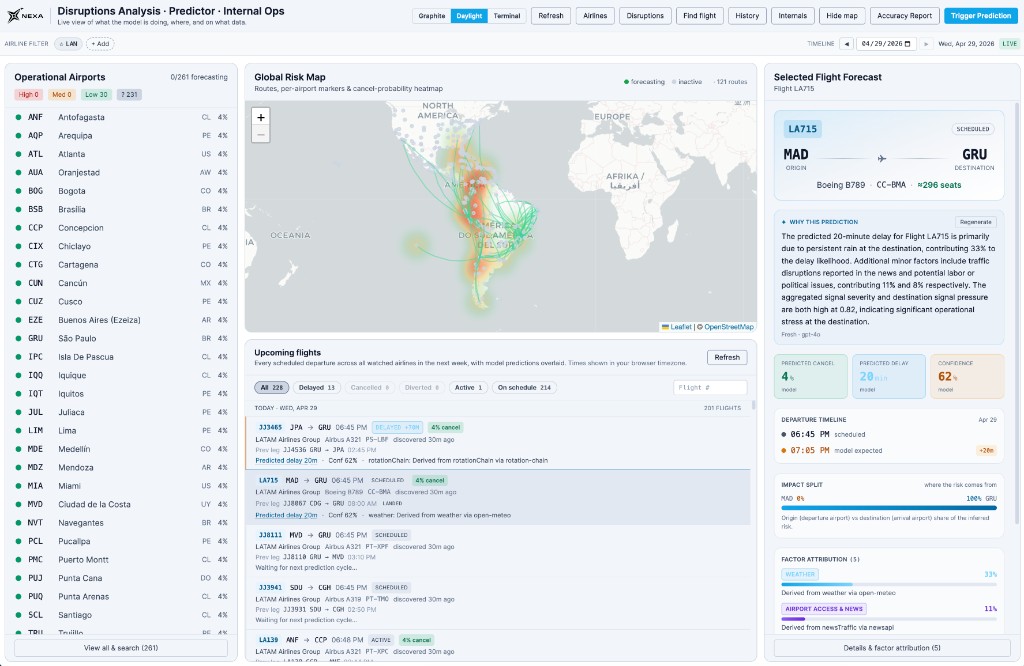
An independent AttributionAgent ranks disruption factors:
weight = severity × confidence × sourceCredibility
Through Nexa Trained Models on Google, this is rendered as immediate operational narratives for the operator: "The 20-minute delay is attributed 33% to persistent rain at destination and 11% to heavy traffic disruptions on the airport's access roads."
Crucially, the narrative agent does not feed the vectors of the underlying ML model — preventing mathematical bias in the prediction while giving the human team absolute, contextually rich auditability.
7. Predictive performance and the asymmetry of operational error
A predictive model deployed in an airline's Operations Control Center (OCC) must make sense both statistically and commercially. In aviation, a mathematical error does not cost the same in both directions.
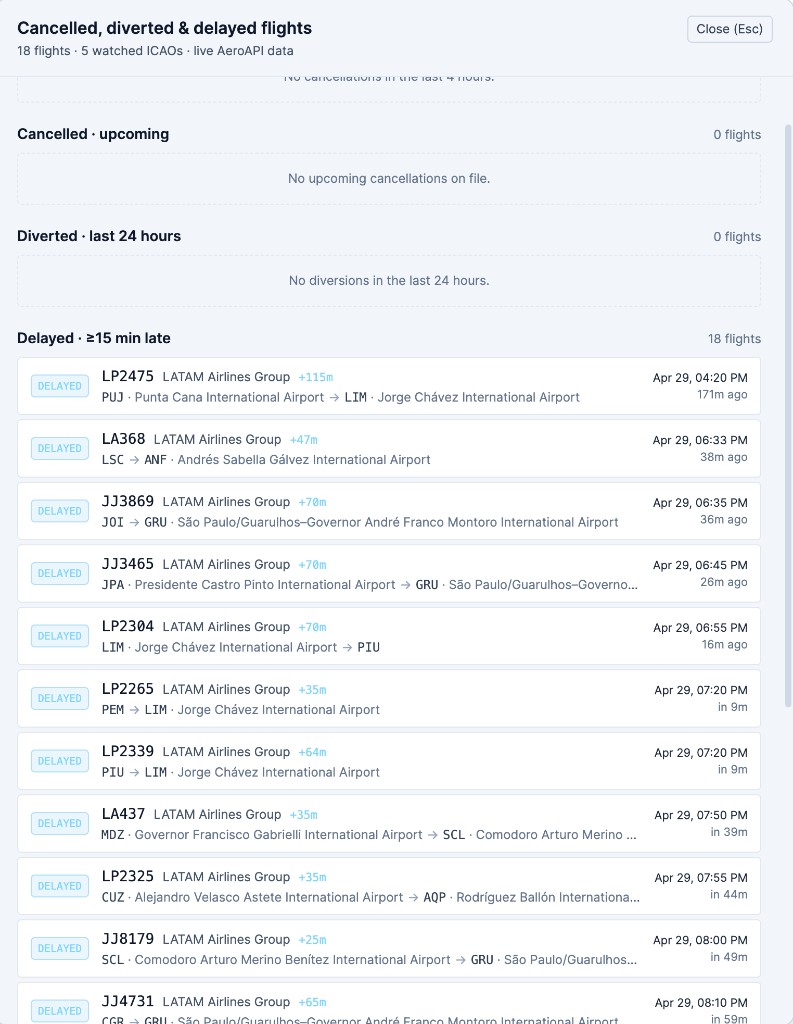
Cancellations — the 80% standard. Predicting cancellations is a hard challenge because the vast majority of flights operate normally. Once Nexa's infrastructure has assimilated the historical volume of the commercial network, the architecture reaches a mature performance of 80% accuracy on real cancellation prediction. Identifying 8 of every 10 cancelled flights hours in advance definitively prevents logistical collapse at the physical terminal.
Delays — the positive-bias strategy. In steady-state operation, the model exhibits a calibrated average bias (over-predicting, e.g. +39 minutes). Far from being a technical defect, this is a deliberate design feature aimed entirely at Customer Success. In crisis scenarios, it applies the golden rule of service: under-promise, over-deliver. Pre-alerting a passenger to a conservative 60-minute adverse scenario and then boarding them in 20 minutes once operational efficiency recovers dramatically reduces anxiety in waiting areas and turns operational friction into a perception of absolute corporate control.
8. Transforming operations: ROI and commercial automation
The real value of Nexa Flight Predictor is making the future actionable for business systems. The architecture lets airlines orchestrate highly profitable mitigation flows:
- Smart rebooking. By anticipating the rotation chain breaking, commercial engines can lock dynamic inventory and proactively rebook high-value passengers (frequent flyers, critical connections) hours before the disruption at the main hub becomes a fact.
- Automated friction containment. Faced with algorithmic certainty of a structural weather delay, the airline can autonomously issue digital food vouchers to the wallets (Apple/Google Pay) of affected passengers. This shifts the wait toward commercial areas and concessions, relieving tension at boarding gates.
- Radically contextual communication. Replacing the generic and opaque "your flight is delayed" with high-transparency, AI-driven notifications: "We have preemptively delayed your takeoff due to severe storms at your destination airport. Your safety and your connecting flight are guaranteed." That transparency dramatically reduces reactive Call Center load — saving millions in support cost.
9. Conclusion: the future lies in anticipation
Knowing where an aircraft is in the sky is yesterday's metric. Anticipating how the logistic and environmental landscape will affect a passenger on the ground is tomorrow's competitive advantage in aviation.
By pivoting toward an airline-centric network intelligence orchestrated by multi-agent systems, Nexa Studio has built an architecture that unifies the rigor of machine learning, operational interpretability (XAI), and pure software-engineering resilience. Nexa Flight Predictor proves that excellence in modern civil aviation is no longer about reactively moving aircraft — it is about giving brands the supreme visibility to orchestrate human logistics flawlessly.
Read next
- Disruption Dashboard — see this architecture in the operations console.
- Flight Disruption Predictor — API guide — how to consume the same predictions over HTTP.
- Inside the Flight Predictor — the full technical deep-dive: feature snapshot, deterministic baseline, runtime/trainer skew, downtime recovery.